
How Gearbox Efficiency Impacts AMR Battery Life: Quantitative Analysis
How gearbox efficiency impacts AMR battery life. Quantitative energy loss model with fleet OPEX calculations and worked examples.
AMR programs usually compare gearbox options on unit price and nominal torque. That misses a major operating-cost driver: conversion loss in the drivetrain. A few points of efficiency gap can change charging cadence, mission continuity, and thermal headroom across the fleet.
In recent RFQ reviews, this is the pattern we keep seeing: unit price looks good on paper, then pilot charging cadence breaks because drivetrain loss was underestimated.
Why Efficiency Matters More Than Catalog Specs Suggest
In most deployments, battery drain is not dominated by peak events. It is dominated by repeated duty over a full shift:
| Operating mode | % of shift time | Power draw level | Efficiency impact |
|---|---|---|---|
| Cruise (loaded) | 35–45% | Medium | High — dominant energy consumer |
| Cruise (empty) | 15–25% | Low-medium | Medium — light-load penalty varies by type |
| Acceleration/decel | 10–15% | High | Medium — short duration limits total energy |
| Stop-start congestion | 10–15% | Low | Low — but adds thermal cycling stress |
| Docking / alignment | 5–10% | Very low | Low — but harmonic-type drives lose efficiency here |
| Standby / idle | 5–15% | Negligible | Negligible |
Because cruise segments repeat thousands of times, small transmission loss becomes cumulative energy cost.
Energy Loss Model for Supplier Comparison
The Math
For any gearbox candidate, the electrical-side power draw at the drivetrain stage is:
P_electrical = P_mechanical / η_gearboxThe extra power consumed by a less efficient gearbox (B vs A) under the same mechanical load:
ΔP = P_mechanical × (1/η_B − 1/η_A)Extra energy consumed over a full shift:
ΔE_shift = ΔP × t_shift_hoursRuntime penalty relative to usable battery capacity:
Runtime_penalty(%) = (ΔE_shift / E_battery) × 100Worked Example
Sensitivity Analysis by Efficiency Gap
| Efficiency gap | Per-shift energy Δ (380W, 10h, 2 wheels) | Annual fleet OPEX Δ (50 robots) | Impact assessment |
|---|---|---|---|
| 1 point (96→95%) | ~85 Wh | ~$155 | Marginal — quantify but don't over-weight |
| 2 points (96→94%) | ~172 Wh | ~$315 | Noticeable in charging cadence |
| 4 points (96→92%) | ~344 Wh | ~$756 | Material — often causes extra daily charge |
| 8 points (96→88%) | ~702 Wh | ~$1,540 | Critical — changes battery/charger architecture |
| 15 points (96→81%) | ~1,380 Wh | ~$3,020 | Disqualifying for battery-optimized platforms |
Calculation assumes: 2× wheel drives, 380 W average mechanical output, 10-hour shift, 365 operating days, $0.12/kWh. Real values vary by deployment.
Efficiency Degradation Over Service Life
Factory-new gearbox efficiency is not lifetime efficiency. Key degradation factors:
| Factor | Typical efficiency impact | Timeline |
|---|---|---|
| Lubricant aging | −1 to −3 points | 3,000–8,000 hours |
| Seal wear | −0.5 to −1 point | 5,000–15,000 hours |
| Bearing preload shift | −0.5 to −2 points | 8,000–20,000 hours |
| Gear surface wear | −1 to −3 points | 10,000–25,000 hours |
| Temperature cycling stress | −0.5 to −1 point | Cumulative |
Recommendation: Request efficiency data at BOL (Beginning of Life) and projected EOL (End of Life) conditions. A gearbox that starts at 95% but degrades to 89% after 10,000 hours delivers worse TCO than one starting at 93% but stable at 91%.
What to Request from Suppliers
Do not accept a single "efficiency" number without context. Here is a minimum-viable data request:
Mandatory efficiency data points
| Data point | Why you need it |
|---|---|
| Efficiency map (load × speed) | Single-point specs hide duty-band losses |
| Test temperature and stabilization time | Efficiency is temperature-dependent |
| Lubricant type and fill level | Different lubricants = different losses |
| Break-in status of test unit | New units may test 1–2% differently |
| Bare gearbox vs integrated assembly | Motor + gearbox system efficiency differs |
| Sample count and variation range | Single-unit test may not represent production |
Suggested RFQ language
Add explicit wording to prevent ambiguous responses:
- "Provide gearbox efficiency data at the following load-speed points: [your 3 duty points]"
- "State test ambient temperature and stabilized gearbox temperature for each point"
- "Provide expected efficiency degradation window over [your maintenance interval]"
- "Indicate whether values are measured at gearbox-only or motor+gearbox system level"
Where Buyers Make Costly Mistakes
1. Comparing mismatched test conditions
A 95% value at 20% rated load is not equivalent to 95% at 80% rated load. Always normalize test points to your operating conditions before commercial comparison.
2. Ignoring thermal coupling
Higher drivetrain loss means more heat. Even if runtime is acceptable, extra heat can:
- Reduce motor torque constant (Kt drops with temperature)
- Accelerate lubricant degradation
- Create hot spots affecting nearby electronics
- Reduce battery charging efficiency if battery is co-located
3. Treating gearbox price as isolated cost
| Hidden cost from lower efficiency | Estimated annual impact (50-robot fleet) |
|---|---|
| Extra energy consumption | $500–$3,000 |
| Accelerated battery degradation | $2,000–$8,000 |
| Additional charger infrastructure | $5,000–$15,000 (one-time) |
| Reduced mission availability | Varies by SLA penalty structure |
4. Skipping lifecycle drift analysis
Initial efficiency may look good, but drift after wear and lubrication interval can materially affect long-term energy budget. Request maintenance interval specifications and efficiency retention guarantees.
Buyer Checklist Before Final Nomination
- Mission duty profile converted to 3+ comparable load-speed operating points
- Efficiency maps from all candidates overlaid at those points (not catalog points)
- Shift-level energy delta calculated and signed by system engineer
- Thermal implication review under actual chassis enclosure conditions
- Lifecycle efficiency degradation assumptions documented
- TCO model (not just unit price) used for final sourcing decision
Decision Rule
If two candidates are close in upfront cost, prioritize the option with better verified efficiency at your real duty band, unless it introduces an offsetting risk in noise, backlash, or reliability.
For most AMR fleets: a verified 2% efficiency advantage saves more over 3 years than a 10% unit price discount.
Related Engineering Guides
- Planetary vs Cycloidal vs Harmonic for AMR — Architecture comparison with efficiency data
- Gearbox MTBF for 24/7 Autonomous Robots — Fleet uptime and total cost modeling
- AMR Gearbox RFQ Template — Include efficiency targets in your RFQ
- Browse Cycloidal Reducer Products
If you want, we can convert your mission profile into a one-page efficiency comparison sheet for shortlist review. Contact [email protected].
Frequently Asked Questions
How much does gearbox efficiency affect AMR battery life?
A 5% difference in gearbox efficiency (e.g., 90% vs 95%) can reduce AMR operating range by 8–12% per charge cycle. For a 48V/30Ah battery pack, this translates to approximately 15–25 fewer minutes of operation per shift, depending on payload and terrain.
Which gearbox losses matter most for battery-powered robots?
Mesh friction (gear tooth contact losses) and bearing losses are the two largest contributors, typically accounting for 60–80% of total gearbox power loss. Seal drag and lubricant churning contribute the remainder. All losses increase with speed and temperature.
How do I calculate the energy cost of gearbox inefficiency for a robot fleet?
Use the formula: Annual energy cost = Fleet_size × Shifts_per_day × 365 × kWh_per_shift × Electricity_cost × (1/η_actual - 1/η_baseline). For a 50-robot fleet operating at 90% vs 95% gearbox efficiency, the energy penalty can exceed $8,000–$15,000 per year.
Does gearbox efficiency degrade over time?
Yes. Gearbox efficiency typically degrades 1–3% over the first 5,000 operating hours due to lubricant aging, seal wear, and bearing surface changes. Regular maintenance (lubricant replacement every 3,000–5,000 hours) helps maintain efficiency within 1% of initial values.
Author
Categories
Need an AMR Gearbox Recommendation?
Reference this article and share your constraints. Our team replies via [email protected].
More Posts
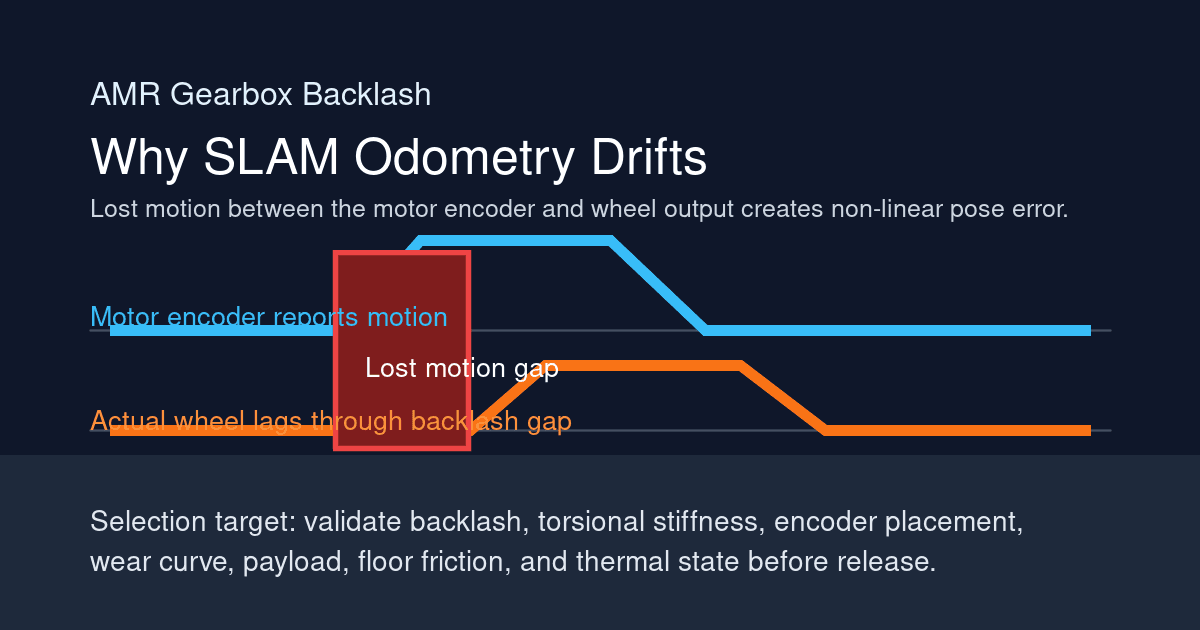
Solving SLAM Odometry Errors: How Gearbox Backlash Impacts AMR Navigation
How AMR gearbox backlash creates odometry drift, when SLAM can compensate, and what drivetrain specs engineers should request before buying.

Low-Noise Gearbox Design for Hospital and Retail AMR: Acoustic Engineering Guide
Low-noise gearbox engineering for hospital and retail AMR. Noise thresholds by environment, architecture comparison, and test protocols.
AMR Gearbox Market Update 2026-W29: The Shift to Integrated Safety Wheel Drives (IDMs)
W29 AMR gearbox sourcing update: why IDMs, EU 2023/1230, ISO 3691-4, noise, lifetime, and TCO are changing reducer RFQs.