
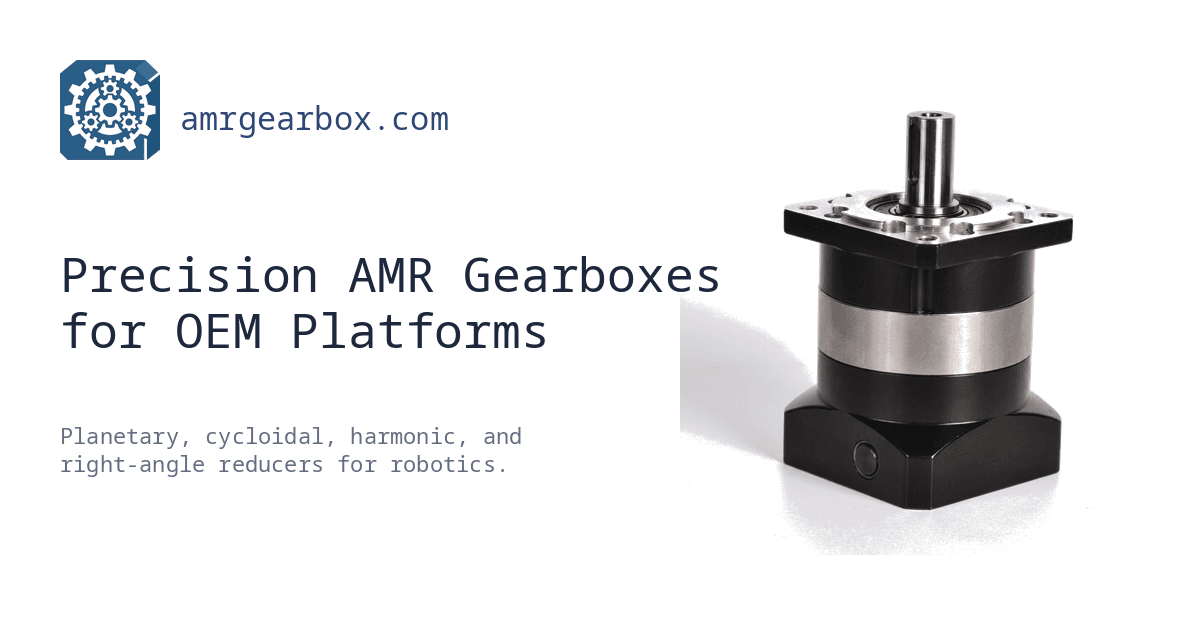
Right-Angle Gearbox Selection for Tight AMR Layouts: Bevel, Worm, and Hypoid Compared
Right-angle gearbox selection for tight AMR layouts. Bevel vs worm vs hypoid comparison with efficiency penalties and decision tree.
Right-angle gearboxes are frequently introduced when AMR packaging reaches a hard limit. But package relief alone is not enough reason to lock architecture. You still need to prove that efficiency, noise, control behavior, and service workflow remain inside program targets.
When Right-Angle Architecture Is Justified
Right-angle paths become high-priority candidates when:
- Coaxial arrangement cannot satisfy chassis height constraints (under 200 mm)
- Motor position conflicts with steering envelope or suspension geometry
- Cable routing and connector access are blocked in straight-line layouts
- Service access improves through directional drivetrain routing
If none of these constraints apply, right-angle adds complexity without clear value.
Right-Angle Architecture Comparison
Three main right-angle technologies compete for AMR applications:
| Parameter | Spiral Bevel | Worm | Hypoid |
|---|---|---|---|
| Efficiency | 93–97% | 45–80% | 90–96% |
| Self-locking | No | Yes (ratio >40:1) | Partial |
| Noise level | Medium (55–65 dB) | Low (45–55 dB) | Medium-low (50–60 dB) |
| Ratio range | 1:1 – 6:1 | 5:1 – 100:1 | 3:1 – 10:1 |
| Torque density | High | Medium | Very high |
| Backlash | 5–15 arcmin | 3–10 arcmin | 3–8 arcmin |
| Cost | Medium | Low | High |
| Thermal sensitivity | Low | High (sliding friction) | Low-medium |
| Best for | High-speed, high-efficiency | Low-speed, self-locking | High-torque, compact |
Efficiency Impact on Battery Life
Right-angle architectures typically lose 1–5% efficiency compared to coaxial planetary. For battery-powered AMR, this matters:
| Architecture | Typical efficiency | Power draw at 380W wheel output | Extra draw vs planetary | Shift penalty (10h) |
|---|---|---|---|---|
| Coaxial planetary | 95% | 400 W | Baseline | — |
| Spiral bevel | 95% | 400 W | ~0 W | ~0% |
| Hypoid | 93% | 409 W | +9 W | +0.3% battery |
| Bevel + planetary stage | 90% | 422 W | +22 W | +0.8% battery |
| Worm (high ratio) | 65% | 585 W | +185 W | +6.9% battery |
Conclusion: Spiral bevel and hypoid are battery-neutral alternatives. Worm drives have a significant energy penalty and should only be used when self-locking is a hard requirement.
Coaxial vs Right-Angle Packaging Comparison
| Dimension | Coaxial (inline) | Right-angle |
|---|---|---|
| Axial length | Motor + gearbox + coupling (long) | Gearbox + output only (shorter in drive axis) |
| Radial footprint | Compact | Wider (perpendicular motor) |
| Height savings | None | 30–60 mm typical for low-profile chassis |
| Motor position | Inline with wheel | Perpendicular — more flexible routing |
| Cable routing | Straight — simple | Often improved access |
| Service extraction | Usually axial pull | Depends on motor mounting — can be easier or harder |
NVH Behavior Differences
Right-angle layouts redirect vibration into mounting structures differently from coaxial setups:
| Source | Coaxial behavior | Right-angle behavior |
|---|---|---|
| Gear mesh vibration | Axial transmission path | Both axial and radial paths |
| Thrust load | Minimal (spur/planetary) | Significant (bevel/hypoid) |
| Housing resonance | Single axis coupling | Multi-axis coupling, harder to isolate |
| Acceleration noise | Primarily gear-mesh frequency | Gear-mesh + bearing thrust noise |
Noise reduction strategies for right-angle layouts
- Thrust bearing quality: Use angular contact or tapered roller bearings with proper preload
- Housing stiffness: Increase rib density near bevel mesh zone
- Mounting isolation: Consider elastomeric isolators between gearbox and chassis
- Tooth contact optimization: Specify flank contact pattern verification in production
Validation Protocol Before Lock-In
| Check | Method | Pass criteria |
|---|---|---|
| Duty-point efficiency | Dynamometer at 3+ load-speed points | Within 2% of coaxial alternative |
| Temperature rise | 2-hour sustained load in enclosed chassis | Below bearing and lubricant limits |
| Noise measurement | Production-intent assembly, 3 speeds | Meet deployment environment target |
| Backlash and repeatability | Under stop/start and load reversal | Within control tuning budget |
| Service replacement trial | Field technician dry-run | ≤ 30 min target (fleet SLA) |
| Shock load survival | 2× rated torque, 1000 cycles | No permanent deformation |
RFQ Specification for Right-Angle Projects
| Field | Content |
|---|---|
| Architecture type | Spiral bevel / hypoid / worm — specify or request recommendation |
| Efficiency at duty points | 3+ load-speed points from Annex A |
| Backlash specification | Test method, preload, temperature |
| Alignment tolerance | Output-to-wheel alignment budget |
| Noise target | dB(A) + spectrum at defined conditions |
| Maintenance interval | Lubricant, bearing, seal replacement schedule |
| Service replacement guide | Recommended tools, time estimate, alignment procedure |
Decision Rule
Choose right-angle when it solves hard packaging constraints and still meets verified lifecycle targets in your actual operating envelope. Prefer spiral bevel or hypoid over worm for battery-powered applications unless self-locking is a hard functional requirement.
If one candidate wins only on fit but loses on efficiency/noise/service robustness, total ownership cost often rises after deployment.
Related Engineering Guides
- Compact Gearbox for Sub-300mm AMR — When right-angle vs compact inline is the better path
- BLDC Motor + Planetary Sizing — Inline alternative sizing methodology
- Low-Noise Gearbox Design — NVH considerations for right-angle layouts
- Browse Right-Angle Gearbox Products
For a project-specific right-angle evaluation matrix and RFQ checklist, contact [email protected].
Frequently Asked Questions
When should I use a right-angle gearbox instead of an inline planetary?
Use right-angle gearboxes when: chassis height is under 200mm and inline arrangement cannot fit, motor position conflicts with steering or suspension geometry, or cable routing is blocked in straight-line layouts. If none of these constraints apply, inline planetary is usually the better choice due to simpler integration and higher efficiency.
Which right-angle gearbox type is best for battery-powered AMR?
Spiral bevel (93–97% efficiency) and hypoid (90–96%) are battery-neutral alternatives to inline planetary. Avoid worm gearboxes for primary wheel drives in battery-powered AMR — at 45–80% efficiency, a worm drive draws 1.6× the electrical power of a 96% planetary, significantly reducing operating range.
Do right-angle gearboxes have more noise problems than inline gearboxes?
Right-angle layouts can redirect vibration into mounting structures differently, creating multi-axis coupling that is harder to isolate. Thrust loads from bevel/hypoid gear mesh add an additional noise source. Careful mounting design with adequate rib stiffening and proper thrust bearing preload can mitigate these issues.
Author
Categories
Need an AMR Gearbox Recommendation?
Reference this article and share your constraints. Our team replies via [email protected].
More Posts
Low-Noise Gearbox Design for Hospital and Retail AMR: Acoustic Engineering Guide
Low-noise gearbox engineering for hospital and retail AMR. Noise thresholds by environment, architecture comparison, and test protocols.

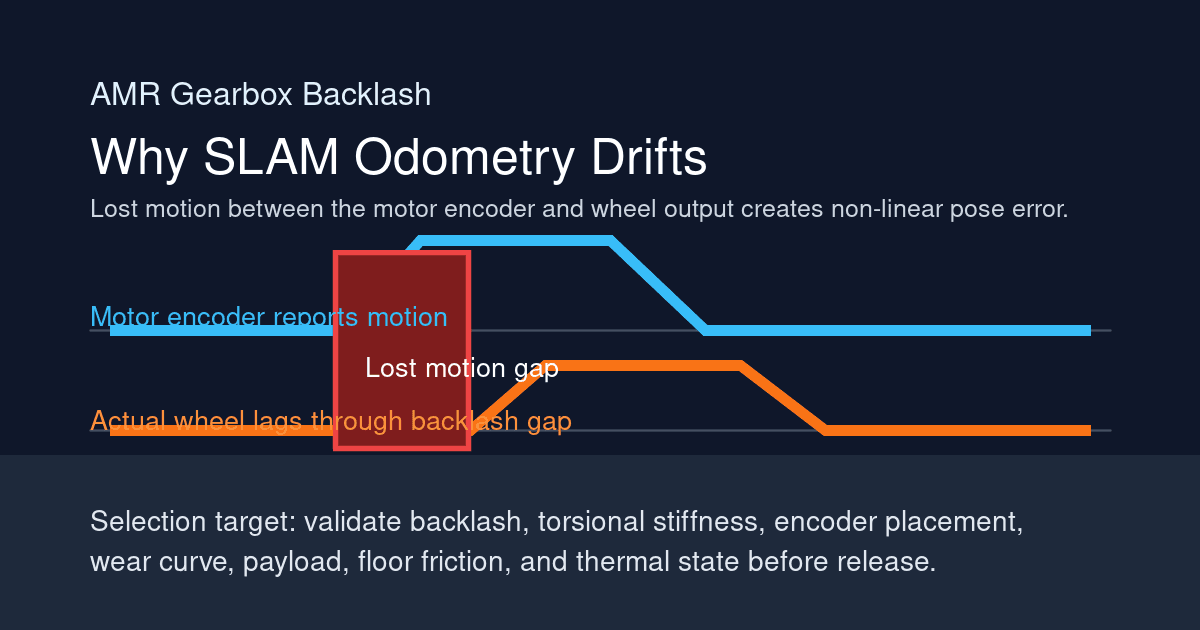
Solving SLAM Odometry Errors: How Gearbox Backlash Impacts AMR Navigation
How AMR gearbox backlash creates odometry drift, when SLAM can compensate, and what drivetrain specs engineers should request before buying.
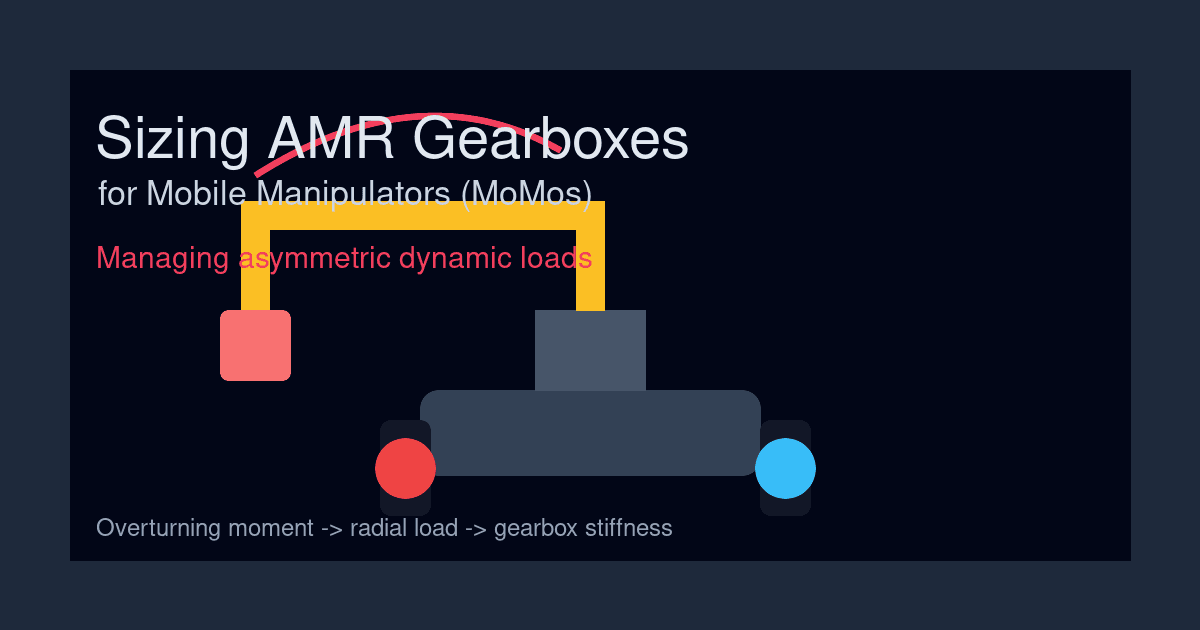
Sizing AMR Gearboxes for Mobile Manipulators (MoMos): Managing Asymmetric Dynamic Loads
Use this AMR gearbox sizing guide to estimate MoMo overturning moments, radial loads, stiffness needs, and RFQ specs for cobot-equipped AMRs.