
Solving SLAM Odometry Errors: How Gearbox Backlash Impacts AMR Navigation
How AMR gearbox backlash creates odometry drift, when SLAM can compensate, and what drivetrain specs engineers should request before buying.
When developing an Autonomous Mobile Robot (AMR), engineering teams invest heavily in high-resolution LiDAR, stereoscopic cameras, and advanced SLAM (Simultaneous Localization and Mapping) algorithms. Yet, during field testing, the robot inexplicably drifts, loses its localization in featureless aisles, or exhibits unstable "hunting" behavior when docking.
More often than not, software engineers will spend weeks tweaking the Extended Kalman Filter (EKF) or ROS navigation stack parameters. However, the root cause is frequently not software—it is mechanical. Specifically, it is gearbox backlash.
For procurement teams and mechanical engineers, understanding how the mechanical "play" or "lost motion" inside a gearbox translates into critical odometry errors is essential. Buying an off-the-shelf gearbox with excessive backlash can effectively blind a sophisticated SLAM system.
In this comprehensive guide, we will break down the mechanics of backlash, how it degrades odometry and SLAM accuracy, the limits of software compensation, and how to source the right gearbox for high-precision autonomous navigation.
Scope and date: Updated July 20, 2026 for global AMR engineering and procurement teams evaluating free-navigating differential, mecanum, swerve, or compact wheel-module robots. The thresholds below are procurement screening targets, not universal design guarantees; validate backlash, stiffness, encoder resolution, payload, floor friction, thermal state, and duty cycle on the assembled drive module before release.
1. The Mechanics of Backlash: What is "Lost Motion"?
Backlash (also known as lash or play) is the clearance or space between mating gear teeth. In any traditional geared transmission, a small amount of clearance is absolutely necessary to allow room for lubrication, prevent gear binding, and accommodate thermal expansion as the gearbox heats up during continuous 24/7 AMR operation.
However, this clearance creates a phenomenon known as "lost motion."
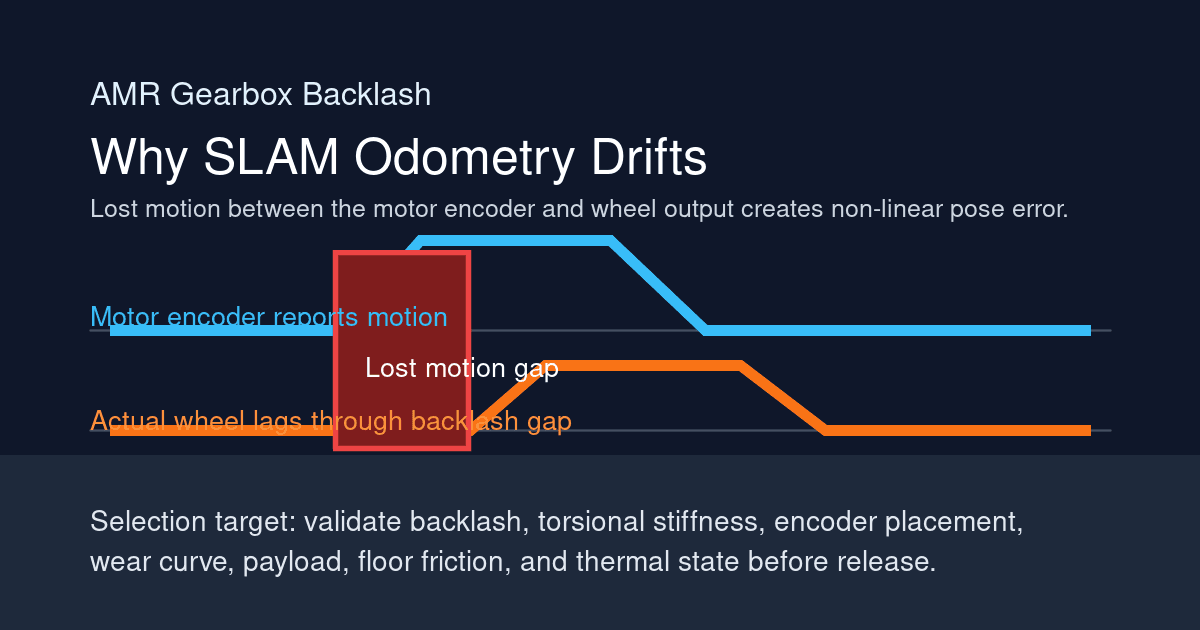
When a motor reverses direction, the motor shaft turns, but the gearbox output shaft (connected to the wheel) does not immediately move. The motor must rotate enough to take up the clearance between the gear teeth before torque is actually transmitted to the wheel. During this microscopic window of time, the motor's encoder registers movement, but the robot's wheel has remained completely stationary.
This disconnect between the motor encoder and the physical wheel is the genesis of odometry degradation.
2. How Backlash Destroys AMR Odometry
Odometry is the use of data from motion sensors to estimate change in position over time. In differential-drive AMRs, odometry heavily relies on wheel encoders. The robot calculates its position ($X, Y, \theta$) by integrating the rotations of the left and right wheels.
Here is exactly how backlash corrupts this mathematical model:
The Linear Translation Error
Backlash is typically measured in arc-minutes (1/60th of a degree). If an AMR uses a standard planetary gearbox with 15 arc-minutes of backlash, and is driving a wheel with a 200mm diameter (100mm radius), we can calculate the linear error at the wheel surface:
- 15 arc-min = 0.25 degrees
- Linear Error = Radius x tan(0.25 degrees)
- Linear Error ~= 100 mm x 0.00436 ~= 0.436 mm
While ~0.44mm of error sounds negligible, this error occurs every single time the motor reverses torque.
The Compounding Effect in Differential Drives
AMRs do not drive in straight lines. To maintain a straight heading, the PID control loop constantly micro-adjusts the left and right wheel speeds. If the robot needs to course-correct, one motor may slightly decelerate or reverse torque.
Every micro-reversal injects that 0.44mm of error into the odometry calculation. Because odometry relies on integrating past positions, these errors compound exponentially over distance. After navigating a 50-meter warehouse aisle, the robot's internal "belief" of its location could be tens of centimeters off from physical reality.
3. The Collision Between Backlash and SLAM
To fix odometry drift, AMRs use SLAM. The SLAM algorithm fuses raw odometry (from the wheels) with environmental data (from LiDAR or cameras) to correct the robot's position on the map.
Why LiDAR Can't Fix Extreme Mechanical Slop
Sensor fusion relies on an Extended Kalman Filter (EKF) or Unscented Kalman Filter (UKF). The filter compares the "predicted pose" (from wheel odometry) against the "observed pose" (from LiDAR).
If the gearbox backlash is high, the wheel odometry becomes incredibly noisy and non-linear, especially during complex maneuvers like turning in place or docking. When the discrepancy between the odometry and the LiDAR data becomes too large, the Kalman Filter struggles to reconcile the two.
- In mild cases, this results in a "fuzzy" or distorted map generation.
- In severe cases (e.g., in featureless environments like a long blank wall where LiDAR has no reference points), the SLAM system is forced to rely solely on odometry. The backlash-induced error takes over, and the robot becomes completely lost.
4. Software Compensation vs. Mechanical Reality
Many software engineers attempt to solve gearbox backlash by writing backlash compensation algorithms. These algorithms detect when the motor reverses direction and artificially inject a rapid "correction move" to take up the gear clearance before resuming the normal trajectory.
The Limits of Software Fixes
While software compensation works for simple CNC machines, it is highly problematic for dynamic AMRs:
- Dynamic Loads: The load on an AMR wheel changes constantly based on payload, floor friction, and incline. Software cannot accurately predict the exact amount of torque needed to take up the backlash gap without causing the robot to "jerk."
- Control Loop Instability: Injecting artificial motion into the drive loop creates oscillations. The AMR's PID controller may start "hunting," causing the robot to vibrate or shimmy when attempting to hold a precise position (e.g., when aligning with a charging dock or conveyor belt).
- Wear is Non-Linear: Backlash increases over time as gears wear down. A software offset calibrated on Day 1 will be completely inaccurate by Month 6.
Conclusion: Software compensation should only be used to mitigate the final few arc-minutes of clearance in an already high-precision gearbox. It cannot fix a mechanically sloppy drivetrain.
5. Gearbox Selection Matrix for AMR SLAM Suitability
For procurement and mechanical engineers, selecting the right gearbox topology is the first line of defense against navigation errors.
Here is a structured comparison of how different gearboxes perform regarding backlash and SLAM compatibility:
| Gearbox Topology | Typical Backlash | Torsional Stiffness | SLAM Odometry Suitability | Best AMR Application | Cost Profile |
|---|---|---|---|---|---|
| Precision Planetary (Helical) | Less than 3 arc-min | High | Excellent | Differential drive AMRs, natural feature navigation. | Medium-High |
| Standard Planetary (Spur) | 8 to 15 arc-min | Medium | Poor to Fair | Magnetic tape/QR code followers (where odometry is less critical). | Low |
| Cycloidal Drive | Less than 1 arc-min | Very High | Exceptional | Heavy-duty pallet AMRs, omnidirectional drives (Mecanum/Swerve). | High |
| Harmonic Drive (Strain Wave) | Zero backlash | Medium | Ultimate Precision | Medical AMRs, semiconductor cleanroom robots, robotic arms. | Very High |
| Standard Worm Gear | 15 to 30+ arc-min | Low | Unacceptable | DO NOT USE for free-navigating autonomous robots. | Very Low |
| Anti-Backlash Worm (Duplex) | Less than 2 arc-min | Medium | Good | Niche applications needing right-angle drives with self-locking. | Medium |
[!TIP] Procurement Strategy: Do not over-spec. A zero-backlash Harmonic drive is incredible, but overkill for a warehouse logistics AMR. A Precision Planetary gearbox (less than 3 arc-min) offers the best ROI, providing enough mechanical rigidity for SLAM algorithms to function flawlessly without breaking the BOM budget.
6. The Hidden Threat: Backlash Degradation Over Time
Procurement teams must be wary of "Day 1 Specs." A gearbox might measure 3 arc-minutes of backlash on the test bench, but what happens after 5,000 hours of continuous stop-and-go driving?
Wear Curves and Surface Hardening
Every time the AMR stops suddenly, the gear teeth impact each other. If the gears are not properly case-hardened or ground, this repetitive impact causes micro-wear. Over months, 3 arc-minutes can easily degrade into 12 arc-minutes.
Suddenly, an AMR fleet that navigated perfectly during commissioning begins failing to dock, drifting into racks, and throwing software errors.
To prevent this, engineers must request the "Backlash Wear Curve" or "B10 Life Data" from the gearbox supplier. High-quality precision gearboxes utilize advanced nitriding or carburizing heat treatments to ensure the backlash remains stable over the rated 10,000 to 20,000-hour lifespan of the robot.
7. Engineering & Procurement Checklist for AMR Drivetrains
When evaluating gearbox suppliers for a free-navigating, SLAM-based AMR, use this checklist to ensure mechanical integration will not sabotage your software team:
- Backlash Specification: Is the maximum backlash explicitly stated on the datasheet as less than 5 arc-min (or better) for SLAM applications?
- Torsional Stiffness: Does the supplier provide data on torsional rigidity? (A gearbox with low backlash but weak stiffness will still act like a "spring" under load, ruining odometry).
- Wear Guarantee: Will the supplier provide empirical test data showing backlash stability over 10,000 hours of simulated stop-and-go load?
- Encoder Placement: Have you coordinated with the motor supplier to ensure high-resolution absolute encoders are used? (Even zero-backlash gearboxes can't save a low-resolution encoder).
- Thermal Impact on Backlash: Does the gearbox maintain its low backlash rating at the robot's maximum continuous operating temperature (e.g., 80°C)?
- Integrated Drive Modules (IDMs): Have you considered sourcing the motor, brake, and gearbox as a single pre-tested assembly to avoid tolerance stack-up during manufacturing?
8. Frequently Asked Questions (FAQ)
Q1: Can we just use a higher resolution LiDAR to compensate for a cheap gearbox?
No. LiDAR updates at a relatively slow rate (typically 10-20 Hz), while the motor control loop and odometry update at 1,000+ Hz. In the time it takes for a LiDAR scan to realize the robot is drifting, the robot has already physically deviated. Fast, accurate odometry is mandatory for stable motor control.
Q2: Why is backlash worse in Omnidirectional or Swerve drive AMRs?
In a differential drive AMR, the wheels generally spin in one direction for long periods. In Swerve or Mecanum drives, the steering and driving motors are constantly making micro-reversals to maintain a vector. Every single reversal triggers the backlash gap, making these architectures extremely sensitive to lost motion.
Q3: How do we measure backlash on an assembled AMR?
You can perform a locked-rotor test. Lock the motor shaft (using the internal safety brake). Then, apply a rated torque (e.g., 2% of nominal torque) to the AMR wheel in both the clockwise and counter-clockwise directions using a torque wrench and a dial indicator. The total angular displacement measured at the wheel is your true system backlash.
9. Conclusion
In the race to build smarter, faster, and more reliable Autonomous Mobile Robots, software often gets the spotlight. However, SLAM algorithms are fundamentally reliant on the physical reality fed to them by the drivetrain. Gearbox backlash is not just a mechanical nuisance; it is a critical source of noise that can blind sensor fusion networks and destroy navigation accuracy.
By investing in high-precision gearboxes—and understanding the limits of software compensation—engineering and procurement teams can ensure their AMRs navigate with millimeter precision from Day 1 to Day 1,000.
Sources / References
- CubeMars Engineering Insights: Analysis on the discrepancy between motor output and encoder readings due to mechanical backlash in robotic joints. cubemars.com
- NavVis SLAM Research: Documentation on SLAM mapping inconsistencies, drift, and the impact of odometry degradation on point cloud generation. navvis.com
- IEEE Robotics / Arxiv: Research on Extended Kalman Filters (EKF), sensor fusion, and the rejection of mechanical noise in differential drive systems. arxiv.org/list/cs.RO/recent
- EU Machinery Regulation 2023/1230: Official requirements context for machinery safety, stability, and predictable control. eur-lex.europa.eu
Is your AMR experiencing navigation drift or docking failures? Stop fighting software and fix the hardware. Connect with our engineering team for a drivetrain consultation and precision gearbox sizing. Request a quote today via our AMR Gearbox RFQ Portal or contact us at [email protected].
Author
Categories
Need an AMR Gearbox Recommendation?
Reference this article and share your constraints. Our team replies via [email protected].
More Posts
AMR Gearbox Market Update (2026-W25): The July 24 Section 122 Clock Now Sets Reducer RFQ and Landed-Cost Strategy
AMR gearbox market update: the July 24 Section 122 clock, May 7 CIT ruling, and ISO/DIS 25268 reshape reducer landed cost and healthcare-AMR sourcing.

AMR Gearbox Market Update 2026-W29: The Shift to Integrated Safety Wheel Drives (IDMs)
W29 AMR gearbox sourcing update: why IDMs, EU 2023/1230, ISO 3691-4, noise, lifetime, and TCO are changing reducer RFQs.
Cold Storage AMR Gearbox Selection: Engineering Guide for -30°C
Cold storage AMR gearbox guide for -30°C: compare grease, seals, IP rating, bearing clearance, RFQ data, and contact AMRGearbox engineering for review.