
Cold Storage AMR Gearbox Selection: Engineering Guide for -30°C
Cold storage AMR gearbox guide for -30°C: compare grease, seals, IP rating, bearing clearance, RFQ data, and contact AMRGearbox engineering for review.
Deploying Autonomous Mobile Robots (AMRs) in cold storage facilities (down to -30°C) is one of the fastest-growing segments in warehouse automation. However, while much attention is paid to battery chemistry and navigation algorithms, the mechanical transmission is often the hidden failure point.
When an AMR drives from an ambient warehouse into a deep-freeze environment, the thermal shock and sustained cold completely alter the physical properties of standard gearboxes. Grease solidifies, seals harden and crack, and thermal contraction creates micro-gaps that invite moisture.
This guide provides a comprehensive framework for engineering and procurement teams to select and specify AMR gearboxes that survive sub-zero environments. It applies to compact AMR wheel drives and mobile robot gear reducers that cycle between ambient staging areas and frozen storage rooms; it does not replace supplier validation for food-contact washdown, ATEX zones, or cryogenic process equipment below -40°C.
For adjacent engineering decisions, see our guides to gearbox efficiency and AMR battery life, gearbox MTBF for 24/7 autonomous robots, and the AMR gearbox RFQ template.
The 3 Failure Modes in Sub-Zero Environments
Before specifying a gearbox, you must understand how cold environments destroy standard off-the-shelf units.
1. Lubricant Solidification (The "Cold Start" Problem)
Standard lithium-based greases are designed for 0°C to 40°C. Below -10°C, the base oil viscosity skyrockets. At -20°C, the grease behaves more like a solid wax. This creates massive internal friction, causing the drive motor to draw excessive current just to break the static friction (stiction). This drastically reduces battery life and can trigger motor overload faults.
2. Seal Brittleness and Condensation
AMRs frequently move between freezing zones and ambient loading docks. This temperature cycling causes condensation. If the gearbox seals (typically Nitrile/NBR) become brittle and shrink at sub-zero temperatures, they lose their interference fit. As the gearbox cools, internal pressure drops, literally vacuuming external moisture and condensation past the compromised seals. This water then freezes inside the gearbox, destroying gears and bearings.
3. Differential Thermal Contraction
A gearbox is built from multiple materials (steel gears, aluminum housings, brass cages). These materials contract at different rates as temperature drops. A bearing fit that is perfect at 20°C may become loose—or overly tight—at -30°C, leading to premature wear and increased backlash.
Standard vs. Cold Storage Gearbox Requirements
To prevent these failures, cold-rated gearboxes require specific engineering modifications. Here is how they compare to standard warehouse AMRs:
| Component / Specification | Standard Warehouse AMR (0°C to +40°C) | Deep Freeze / Cold Storage AMR (-30°C) |
|---|---|---|
| Lubrication Type | Standard Lithium Grease (NLGI 2) | Synthetic Low-Temp Grease or PAO-based Oil |
| Lubricant Pour Point | -10°C to -15°C | -40°C to -50°C |
| Seal Material | Nitrile Rubber (NBR) | Silicone, PTFE, or Special Low-Temp FKM |
| IP Rating Requirement | IP54 (Dust & Splash) | IP66 / IP67 (Washdown & Condensation Proof) |
| Housing Material | Standard Cast Aluminum | Treated Aluminum / Stainless Steel (anti-corrosion) |
| Breather Valve | Vented or unsealed | Hermetically sealed or desiccant breather |
| Bearing Clearance | Standard Clearance (CN) | C3 / C4 (Larger clearance for thermal contraction) |
| Typical Efficiency Loss | ~2-5% at startup | ~10-15% at startup (until warmed) |
Note: Even with low-temperature grease, expect a slight efficiency drop during the first few minutes of operation in a deep freeze as the internal components "warm up" through friction.
Visualizing Viscosity: Why Standard Grease Fails
Procurement & Engineering Checklist for Sub-Zero Gearboxes
When evaluating suppliers or submitting an RFQ for cold-storage AMR drives, ensure the following requirements are explicitly stated:
- Specify Minimum Operating Temperature: Do not just state "cold storage". Explicitly state the lowest temperature (e.g., -30°C) and the duration of exposure.
- Require Low-Temp Lubricant Certification: Ask the gearbox manufacturer to provide the technical datasheet (TDS) for the grease used, proving a pour point at least 10°C below your lowest operating temperature.
- Verify Seal Materials: Ensure seals are rated for sub-zero flexibility (e.g., specific Silicone or PTFE blends). Reject standard NBR seals.
- Mandate IP66 or Higher Sealing: The gearbox must be protected against condensation. Some suppliers use positive pressure or hermetic sealing.
- Request Cold-Start Torque Data: Ask for the exact starting torque required at -20°C or -30°C to ensure your drive motors and motor controllers are not undersized.
FAQ: Cold Storage AMR Gearboxes
Q: Can we just use thinner oil instead of grease?
A: While oil handles cold better than grease, it requires much stricter sealing to prevent leaks, especially in vertical axes or rough terrain. Most compact AMR wheel drives use grease for lifetime maintenance-free operation. If using oil, the gearbox must be specifically designed for it with appropriate breather valves.
Q: How does cold storage affect gearbox service life (L10)?
A: If properly specified with synthetic low-temp lubrication and appropriate seals, the theoretical L10 bearing life should remain similar to ambient operation. However, in practice, the risks of condensation and moisture ingress are the primary causes of premature failure, not mechanical wear.
Q: Do we need a heater for the gearbox?
A: Usually, no. The AMR's drive motor and battery often require thermal management (heaters), but the gearbox itself does not generate enough heat to matter, nor is it sensitive enough to require active heating—provided it was filled with the correct synthetic low-temperature grease at the factory.
Sources and Verification Notes
- SKF bearing lubrication guidance explains why grease selection depends on operating temperature, base oil viscosity, and application conditions: Selecting a suitable grease.
- Controls Drives Automation documents cold-chain AMR constraints, including low-temperature material degradation, condensation, icing, and movement between cold and temperate spaces: AMR revolution in cold chain logistics.
- NIST cryogenic materials data provides a reference point for material-property changes and thermal contraction considerations across aluminum and stainless steel families: Material Properties.
Use these sources as engineering context, then request model-specific lubricant TDS, seal compound data, IP test evidence, and cold-start torque curves from each gearbox supplier before approval.
Next Steps for AMR Engineering Teams
Specifying the wrong gearbox for a cold storage AMR leads to catastrophic field failures, voided warranties, and expensive on-site maintenance in sub-zero environments.
At AMR Gearbox, we provide application-specific drive solutions engineered for extreme environments. Whether you need a low-temperature planetary drive for a pallet-moving AMR or a fully sealed washdown cycloidal unit, our engineering team can help.
Contact our engineering team for a technical review of your cold-storage AMR drive requirements.
Author
Categories
Need an AMR Gearbox Recommendation?
Reference this article and share your constraints. Our team replies via [email protected].
More Posts
AMR Gearbox Sourcing W30: 2026 Section 301 Tariffs
AMR gearbox sourcing guide for 2026 Section 301 tariff risk. Verify HTS codes, origin evidence, duty scope, and RFQ timing before supplier nomination.

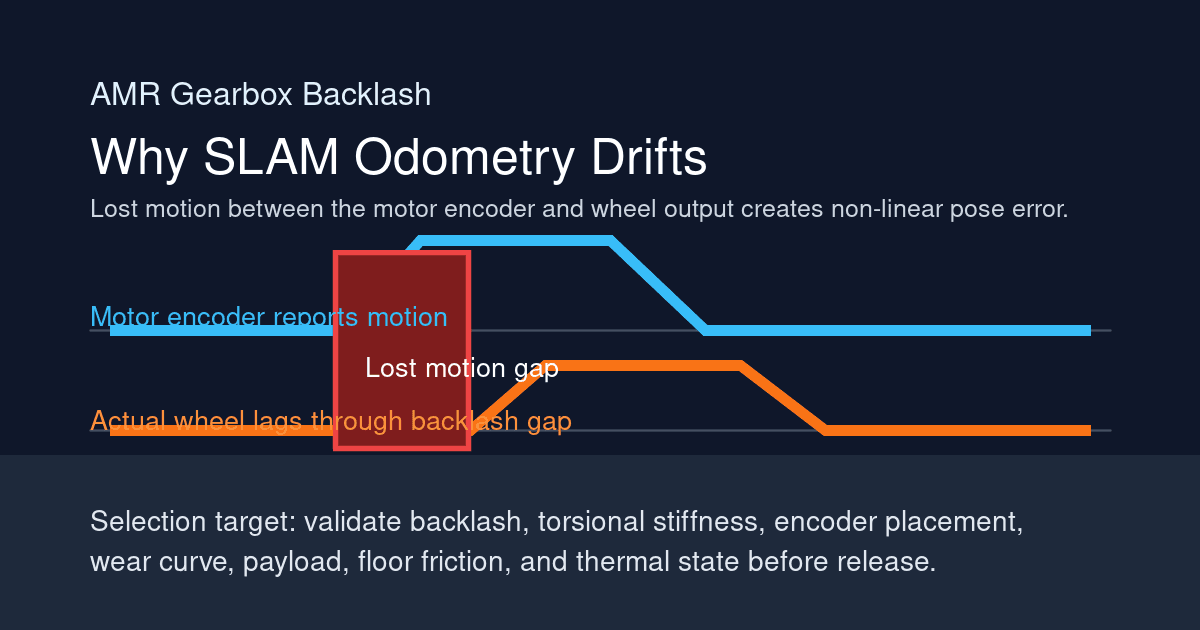
Solving SLAM Odometry Errors: How Gearbox Backlash Impacts AMR Navigation
How AMR gearbox backlash creates odometry drift, when SLAM can compensate, and what drivetrain specs engineers should request before buying.
Right-Angle Gearbox Selection for Tight AMR Layouts: Bevel, Worm, and Hypoid Compared
Right-angle gearbox selection for tight AMR layouts. Bevel vs worm vs hypoid comparison with efficiency penalties and decision tree.